Guntur vs Byadgi chillies: Teja S17, Sannam S4, 341 and Byadgi grades explained
By Sahibzada Yamin Yaqoob, Export desk, Prime Harvest GlobalPublished
Chilli is India's largest spice export by both value and volume, worth roughly US$1.1 billion in 2025-26 according to Spices Board of India figures. China, Thailand, Bangladesh, the USA and Sri Lanka are among the biggest buyers. Yet buyers new to Indian chilli often get a list of grade names with no explanation, and end up ordering on price alone.
That usually goes wrong. A seasoning maker who needs colour and orders a heat grade gets a blend that burns and looks dull. A sauce maker who needs heat and orders a colour grade has to use twice as much.
This guide covers the four grades we grow on contract in Guntur (Andhra Pradesh) and Byadgi (Karnataka), what each one is for, and what to test before a lot leaves India.
Two numbers decide the grade
Indian dried red chillies are bought on two measures.
Heat is measured in Scoville Heat Units (SHU). It reflects how much capsaicin the chilli carries.
Colour is measured as ASTA colour, a scale set by the American Spice Trade Association. A higher number means a deeper red, and more colour per kilo of chilli in your product.
Most chillies are strong on one and average on the other. Picking a grade means deciding which one you are paying for.
The four grades at a glance
| Grade | Region | Heat (SHU) | Colour (ASTA) | Bought for |
|---|---|---|---|---|
| Byadgi | Karnataka | 8,000 to 16,000 | 150 to 200 | Colour |
| Sannam S4 | Guntur | 18,000 to 30,000 | 50 to 80 | All-round use |
| 341 Deluxe | Guntur | 20,000 to 65,000 | 80 to 150 | Heat with good colour |
| Teja S17 | Guntur | 75,000 to 100,000 | 60 to 80 | Heat |
These are typical ranges. The figure for your actual lot goes on its certificate of analysis, and that is the number to hold a supplier to.
Byadgi: when the red matters most
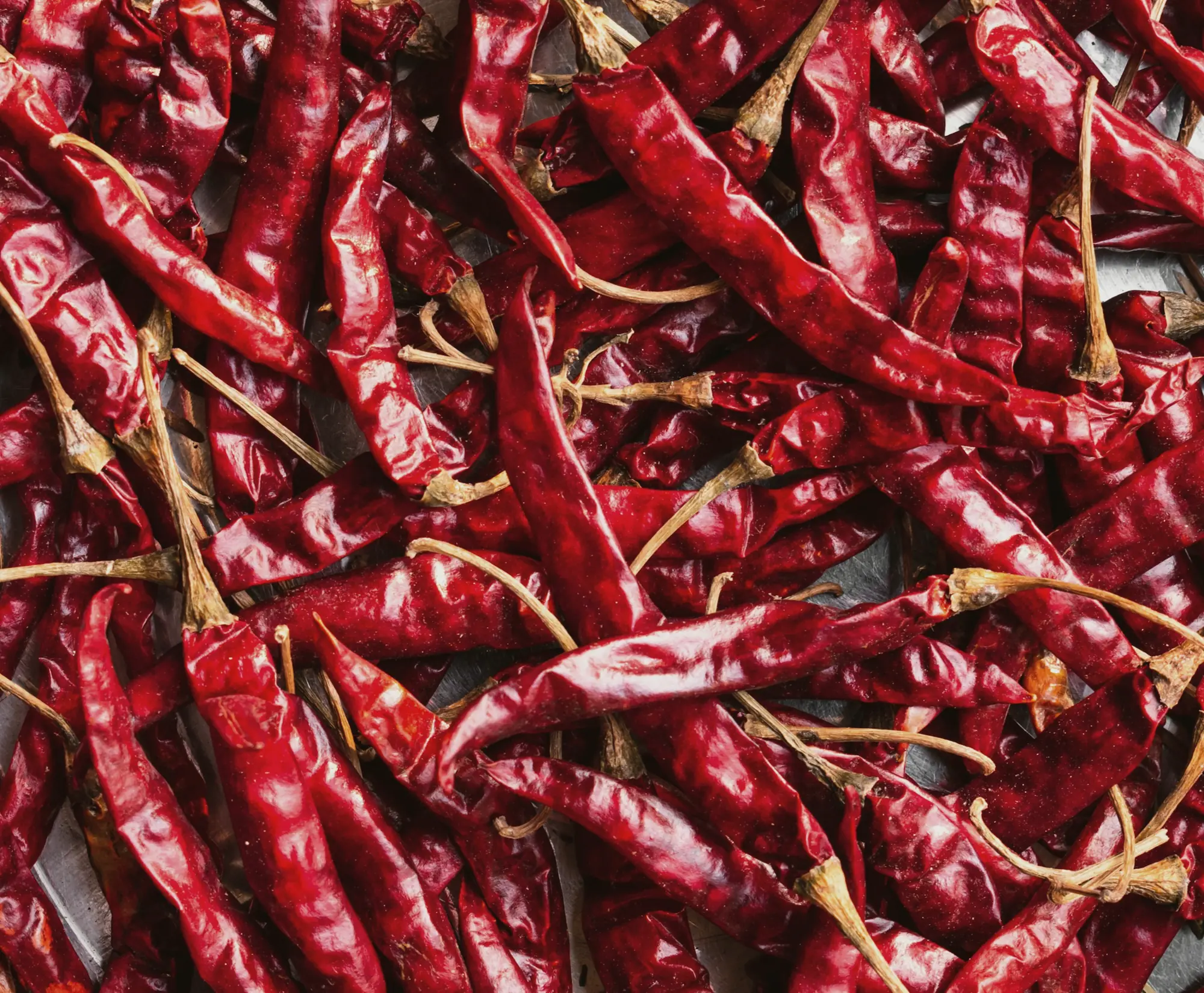
Byadgi is the colour grade. It is mild, at 8,000 to 16,000 SHU, with ASTA colour of 150 to 200, the highest of the four. The pods are wrinkled and deep red.
Buyers use Byadgi where the colour of the finished product matters more than the heat: seasoning blends, curry powders, sauces, and paprika-style uses. It is also a common choice when a recipe needs a mild chilli flavour without much burn.
Teja S17: when heat is the point
Teja S17 is the heat grade from Guntur, running 75,000 to 100,000 SHU, with colour of 60 to 80 ASTA. Because it is so hot, you use less of it for the same effect. Hot sauces, spicy snack seasonings and other heat-led products are where Teja earns its price.
When you compare Teja quotes, ask for the SHU figure on the CoA. A lot at 75,000 and a lot at 100,000 behave like different products in a recipe.
Sannam S4 and 341 Deluxe: the middle ground
Sannam S4 sits at 18,000 to 30,000 SHU with 50 to 80 ASTA. It is the general-purpose Guntur chilli, used widely where neither heat nor colour needs to be extreme.
341 Deluxe has the widest range, at 20,000 to 65,000 SHU and 80 to 150 ASTA. It suits buyers who want real heat but cannot give up colour, and it is useful in blends where you would otherwise mix two grades.
How to choose a grade
A rough way to decide:
- If customers judge your product by its colour, start with Byadgi.
- If they judge it by its heat, start with Teja S17.
- If you need both, look at 341 Deluxe.
- If you need a dependable everyday chilli, Sannam S4.
Many buyers blend. A colour grade and a heat grade mixed to a target gives more control than relying on one grade's natural range. If you are not sure, order 0.5 MT of two grades and run them through your own line. That is what our minimum is set for.
What to test before a chilli lot ships
Grade decides whether the chilli works in your product. Testing decides whether it gets through your border.
Aflatoxin is the test that most often gets chillies rejected. It comes from mould, and chillies pick it up when they dry slowly in heat and humidity or are stored damp. The EU limit is 5 µg/kg for aflatoxin B1 and 10 µg/kg total.
Sudan dyes I to IV are illegal industrial dyes that have been used to make poor chilli look redder. Our chilli lots ship with a Sudan dye test certificate as standard.
For the EU, the border also checks ethylene oxide (0.1 mg/kg, counted with 2-chloroethanol) and ochratoxin A (20 µg/kg). Indian chilli is on the EU list for increased official controls under Regulation (EU) 2019/1793, and 20% of consignments are checked for ethylene oxide. The UK has chilli on its list for elevated checks too, for mycotoxins and pesticide residues. The wider picture, spice by spice, is in why Indian spice shipments get rejected.
Every chilli lot we ship is tested at a third-party lab accredited by NABL to ISO/IEC 17025, against the limit in your country's standard, before it is packed. You can see the limits for your destination in the spec checker, and the market rules on our UK import page and USA page.
Documents that ship with Indian chillies
| With every lot | Added for chillies |
|---|---|
| Phytosanitary certificate | Aflatoxin test certificate |
| Certificate of origin | Sudan dye I to IV test certificate |
| Certificate of analysis | |
| FSSAI licence, IEC and Spices Board registration |
For a first order, our import checklist covers the full document list and the order process.
Common questions about Indian chilli grades
Which Indian chilli is the hottest?
Of the main export grades, Teja S17, at 75,000 to 100,000 SHU.
Which Indian chilli has the best colour?
Byadgi, at 150 to 200 ASTA.
What is the difference between Guntur and Byadgi chillies?
Guntur, in Andhra Pradesh, grows the heat-led grades such as Teja S17, Sannam S4 and 341 Deluxe. Byadgi, in Karnataka, grows a mild chilli prized for its deep red colour.
What is the minimum order for Indian chillies?
With us, 0.5 MT per grade, or 1 MT for private label.
Get a price on your grade
Tell us the grade, volume and destination port, and we will price your chillies in US dollars on FOB, CIF or EXW, with a sample and the CoA for its lot before you pay. All four grades, with their specs and documents, are on our red chilli exporter page. When you are ready, request a quote.